Skip to content
  • Homepage
  • Catalog
  • Collections
  • Journal
  • Shipping Policy
  • Contacts
LordAntiques
  • Homepage
  • Catalog
  • Collections
  • Journal
  • Shipping Policy
  • Contacts
  • Account
    Other sign in options Sign in
    • Orders
    • Profile
    Account
    Other sign in options Sign in
    • Orders
    • Profile
    Your cart is empty

    Have an account? Log in to check out faster.

    Continue shopping

    The History of Delft Blue Pottery: From Chinese Inspiration to a Dutch Icon

    Few decorative arts are as closely associated with the Netherlands as Delft Blue pottery. Recognizable by its cobalt-blue decoration on a white background, Delftware has become one of the most enduring symbols of Dutch craftsmanship. For more than three centuries it has decorated homes, appeared in royal collections, and attracted the attention of collectors around the world.

    Yet the story of Delft Blue did not begin in Delft.

    The origins of this iconic ceramic tradition can be traced to the arrival of Chinese porcelain in Europe during the seventeenth century. What began as an attempt to imitate imported luxury goods gradually evolved into a uniquely Dutch art form with its own character, techniques, and history.

    The Arrival of Chinese Porcelain in Europe

    During the late sixteenth and early seventeenth centuries, European merchants developed increasingly active trade routes with Asia. Among the most sought-after imports was Chinese porcelain, particularly the blue-and-white wares produced during the Ming Dynasty.

    To European buyers, porcelain seemed almost miraculous. Its bright white surface, delicate decoration, and remarkable durability were unlike anything produced locally. Wealthy households eagerly purchased Chinese pieces, and demand quickly grew across the continent.

    However, political instability in China during the mid-seventeenth century disrupted porcelain exports. European merchants suddenly faced shortages of a product that had become highly fashionable.

    Dutch potters recognized an opportunity.

    Why Delft Became the Center of Production

    The city of Delft was already known for its ceramic industry. Local workshops had experience producing earthenware and possessed access to skilled craftsmen, trade networks, and suitable materials.

    When Chinese porcelain became more difficult to obtain, Delft potters began experimenting with ways to recreate its appearance. Since true porcelain production remained unknown in Europe at the time, they developed an alternative using tin-glazed earthenware.

    A white tin glaze provided a bright surface that resembled porcelain. Decorative motifs were then painted by hand using cobalt oxide, producing the characteristic blue designs that remain associated with Delftware today.

    By the middle of the seventeenth century, dozens of pottery workshops operated in Delft. Many former breweries, no longer profitable, were converted into ceramic factories. The city rapidly transformed into the leading center of Dutch pottery production.

    The Golden Age of Delftware

    The seventeenth century is often referred to as the Dutch Golden Age, a period marked by economic prosperity, maritime trade, and cultural achievement.

    Delftware flourished during this era.

    Potteries produced an astonishing variety of objects, including:

    • Plates and chargers
    • Vases
    • Tiles
    • Apothecary jars
    • Tea sets
    • Decorative figurines
    • Wall plaques
    • Religious and commemorative objects

    Although Chinese porcelain remained an important source of inspiration, Delft painters gradually developed their own artistic vocabulary. Dutch landscapes, biblical scenes, floral motifs, windmills, sailing ships, and everyday life increasingly appeared in their designs.

    The result was no longer a simple imitation of Asian ceramics but a distinctly European interpretation.

    How Delft Blue Pottery Was Made

    The production of Delftware required considerable skill.

    The process typically began with shaping the clay body. Once the object was formed and dried, it received a coating of white tin glaze. This glaze created the bright surface that allowed painted decoration to stand out clearly.

    Artists then applied designs by hand using cobalt pigments. Because the colors appeared dull before firing, painters needed experience to predict how the final decoration would look after the kiln process.

    After firing, the cobalt transformed into the vibrant blue tones for which Delftware became famous.

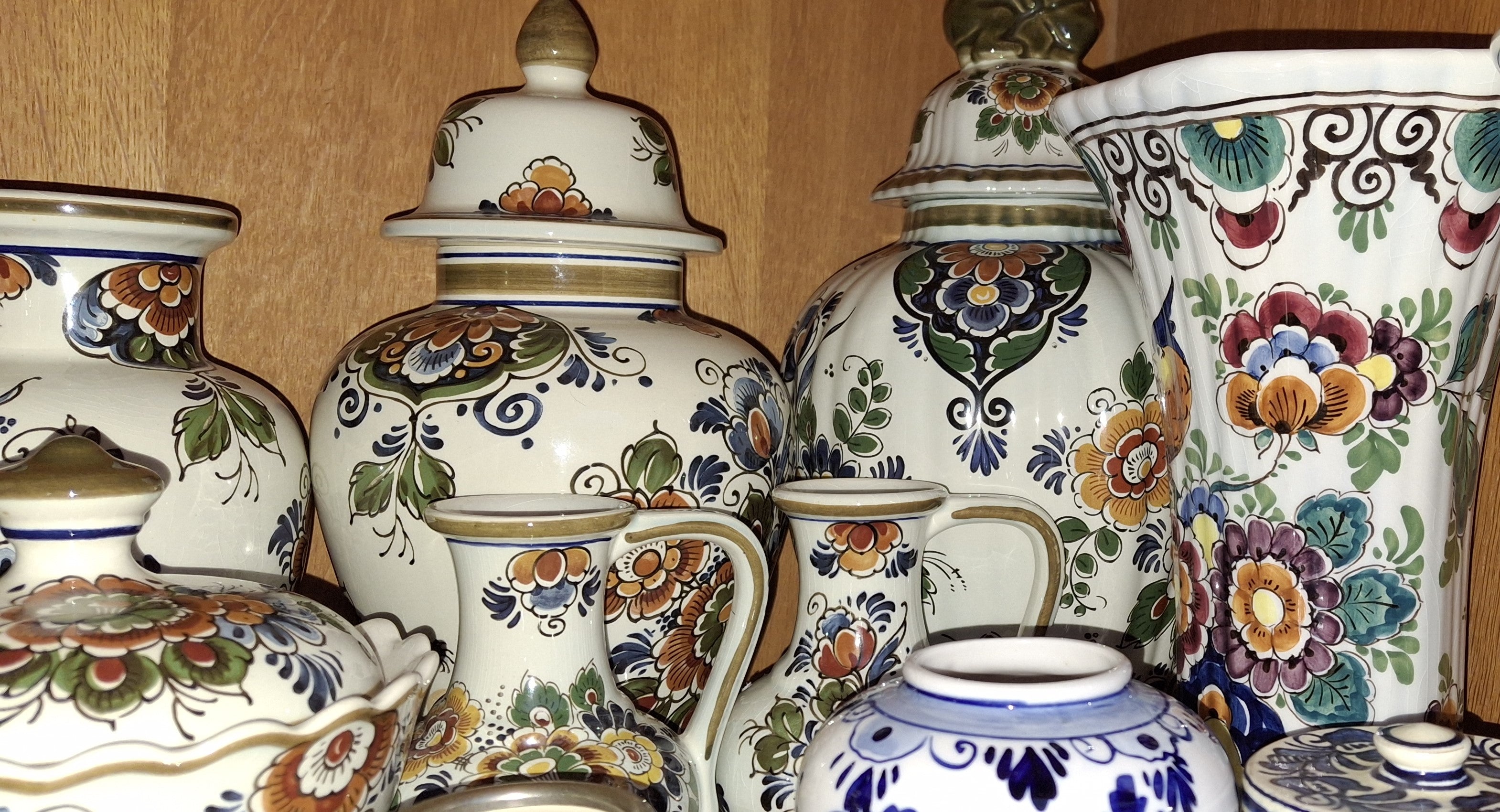
    The quality of decoration varied between workshops and periods. Some pieces display simple floral motifs, while others feature highly detailed scenes executed with remarkable precision.

    Even today, the best examples demonstrate an extraordinary level of craftsmanship.

    Famous Delft Potteries

    During the peak of production, more than thirty pottery factories operated in Delft.

    Many workshops adopted distinctive names, often displayed on signs outside their buildings. Examples included:

    • The Porceleyne Fles
    • The Double Tankard
    • The Peacock
    • The Metal Pot
    • The Three Bells

    Each factory developed its own style, marks, and decorative preferences.

    Of these historic manufacturers, Royal Delft (De Porceleyne Fles), founded in 1653, remains the most famous and is the only seventeenth-century Delft pottery company still operating today.

    Factory marks found on the underside of objects are often valuable clues for collectors attempting to identify origin and age.

    Decline and Revival

    Despite its success, Delftware eventually faced serious competition.

    By the eighteenth century, European manufacturers had learned to produce true porcelain. Factories such as Meissen in Germany and later Sèvres in France introduced products that rivaled both Chinese imports and Dutch tin-glazed pottery.

    Changing tastes also influenced consumer demand.

    Many Delft factories closed during the eighteenth and nineteenth centuries. Production declined significantly, and some traditional techniques were nearly forgotten.

    However, interest in historic craftsmanship revived during the late nineteenth century. Collectors, museums, and scholars began to recognize Delftware as an important part of Dutch cultural heritage.

    This renewed appreciation helped preserve surviving workshops and encouraged continued production.

    How to Recognize Authentic Delftware

    One of the most common questions among collectors concerns authenticity.

    While identifying Delftware requires experience, several characteristics may provide useful clues:

    Tin-Glazed Surface

    Traditional Delftware typically features a soft, slightly uneven tin-glazed surface rather than the glass-like appearance of modern porcelain.

    Hand-Painted Decoration

    Authentic pieces often reveal subtle variations in brushwork. Minor irregularities can be signs of genuine hand-painted craftsmanship.

    Factory Marks

    Many historic workshops used identifying marks on the underside of their wares. These marks may help determine origin, manufacturer, and approximate date.

    Signs of Age

    Older pieces frequently display wear consistent with their age. Surface scratches, glaze imperfections, and minor edge wear are often expected in genuine antique examples.

    Collectors should always evaluate age, condition, provenance, and decoration together rather than relying on a single feature.

    Delft Blue in Modern Interiors

    Despite its centuries-old history, Delft Blue remains remarkably relevant today.

    Its combination of white and cobalt blue works comfortably within both traditional and contemporary interiors. Antique Delft plates are frequently displayed on walls, while vases and decorative objects continue to serve as focal points in modern homes.

    Collectors appreciate Delftware not only for its beauty but also for the historical stories embedded within each piece.

    Every object reflects a period when global trade, artistic exchange, and local craftsmanship combined to create something entirely new.

    Why Delftware Continues to Fascinate Collectors

    Few ceramic traditions have enjoyed such lasting appeal.

    Delft Blue pottery represents more than decorative craftsmanship. It tells a story of international trade, cultural influence, technical innovation, and artistic adaptation. What began as a Dutch response to imported Chinese porcelain gradually evolved into one of the most recognizable forms of European ceramics.

    For collectors today, each Delft piece offers a tangible connection to that history.

    Whether a simple decorative plate, a finely painted vase, or an eighteenth-century charger, Delftware continues to embody the enduring relationship between beauty, craftsmanship, and cultural heritage.

    At LordAntiques, we remain fascinated by these objects and the stories they carry across generations. Their continued presence in collections and homes around the world is perhaps the strongest evidence that true craftsmanship never goes out of style.

    Shop now
    Shipping policy
    • We ship your order within 2 business days from the date of payment confirmation.
    • After dispatch, you will receive an email with tracking details so you can follow your package.
    • Delivery Estimates by Region:
      European Union: 3–7 business days. United States: 10–15 business days. Rest of the World: 10–21 business days.
    Return policy
    • Damaged or misrepresented items
      Notify us within 7 calendar days of delivery and attach photos (including packaging). We will offer a partial refund, replacement, or other suitable resolution.
    • General returns (non-defective items)
      Eligible within 14 days of delivery. Items must be unused, in original condition, and returned at your expense unless otherwise agreed.
    • Returns involving duties or VAT
      Customs duties and VAT are typically non-refundable through customs authorities. While we will process a product refund once the returned item is received, you may still incur non-refundable taxes or duties at your local customs.
    • Missing or incorrect deliveries
      Contact us immediately if you suspect a delivery issue so we can resolve it promptly.
    Import Duties & VAT Information

    Please note that import duties, VAT/GST, and possible customs fees may apply when your package arrives in your country. These charges are set by the destination country and are the buyer’s responsibility.

    Such charges may apply for orders shipped to: United States, Canada, United Kingdom, Norway, Switzerland, Australia, New Zealand, South Africa, Turkey, India, Japan, China.
    Shop now

    Subscribe to our newsletter and get 10% off your first order

    © 2026 LordAntiques, Powered by Shopify
    • Privacy policy
    • Refund policy
    • Contact information
    • Shipping policy
    • Terms of service